
 Introduction:
The Question Everyone Is Thinking About
Let’s pause and be real for a second.
In 2026, AI isn’t just around us; it’s woven into daily life. It drafts emails before we finish our coffee, breaks down complex topics in seconds, and helps generate everything from designs and code to marketing ideas, legal drafts, and even medical summaries. Basically, the question is Can AI Replace Experts?
Because of that, one question keeps quietly surfacing in offices, online communities, and late-night discussions:
Can AI actually replace experts?
Could AI take over the roles of doctors, lawyers, developers, teachers, marketers, consultants, analysts, or creators?
Or are we moving toward a future where human expertise still matters — just in a different, more evolved form?
This article isn’t meant to create fear.
And it’s definitely not here to sell AI as a magical replacement for human intelligence.
Instead, think of this as a grounded, practical reality check — written for people who want to understand where AI truly stands in 2026, what it does well, where it clearly falls short, and why human experts still play a critical role despite the hype. AI cannot actually replace experts.
Why This Question Matters So Much Right Now
Not long ago, AI felt optional. Interesting, yes — but distant. Something you experimented with, not something you relied on.
That era is over.
Today, AI tools are actively used for:
-
summarizing medical research
-
drafting legal documents
-
writing and reviewing code
-
planning business strategies
-
analyzing financial data
-
creating content
-
handling customer support
-
supporting education and learning
When a tool starts influencing decisions, careers, money, and credibility, it’s natural for people to worry about replacement.
But the fear usually isn’t just about losing jobs.
It runs deeper than that. But it is not about fearing this. Can AI replace experts?
👉 If AI can perform expert-level tasks, what role is left for humans?
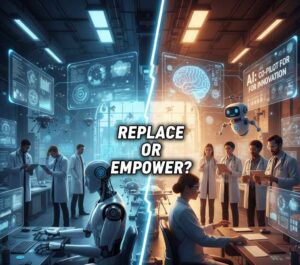 What People Really Mean When They Say “Experts”
Before answering whether AI can replace experts, we need to be clear about what an expert actually is.
An expert isn’t just someone who:
-
memorizes facts
-
follows instructions
-
repeats information
True expertise includes:
-
real-world experience (including failures)
-
judgment built over time
-
awareness of context and nuance
-
ethical responsibility
-
accountability for results
That difference matters more than ever.
AI is excellent at handling information.
Experts are responsible for interpretation, consequences, and decisions.
How AI Actually Works (And Why That Matters)
AI still doesn’t think the way humans do.
At its core, AI works by:
-
analyzing massive amounts of data
-
spotting patterns
-
predicting the most likely response
What it doesn’t do:
-
understand consequences
-
feel responsibility
-
experience uncertainty the way humans do
-
learn from lived experience
That’s why AI can sound extremely confident — and still be wrong.
And confidence without responsibility is exactly where replacement becomes risky.
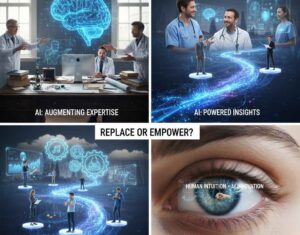 Where AI Looks Like It’s Replacing Experts
To be fair, there are areas where AI appears to outperform humans — at least on the surface.
Speed and Scale
AI can:
-
Scan thousands of documents instantly
-
generate drafts in seconds
-
process data faster than entire teams
For repetitive, data-heavy tasks, AI clearly has the advantage.
Instant Access to Knowledge
AI has immediate access to:
-
research papers
-
technical documentation
-
historical records
-
best-practice frameworks
That alone can make AI seem “smarter” than beginners — and even some professionals.
Standardized, Rule-Based Work
Tasks with clear patterns and rules, such as:
-
basic coding
-
template-based writing
-
data formatting
-
simple analysis
These are areas where AI can strongly assist — and sometimes replace entry-level work.
But here’s where the misunderstanding starts.
Assistance Is Not the Same as Replacement
This is the line most discussions miss.
AI replacing tasks is not the same thing as AI replacing experts.
Experts don’t just complete tasks. They:
-
make judgment calls
-
assess risk
-
adapt to unexpected situations
-
Take responsibility when things go wrong
AI does none of that.
Where AI Clearly Cannot Replace Experts
This is where AI’s limits become impossible to ignore.
High-Stakes Decisions
In fields like medicine, law, finance, and engineering:
-
One mistake can cause real harm
-
context matters more than raw data
-
Ethical judgment is essential
AI can help with research, summaries, and suggestions — but final decisions must remain human.
Accountability and Trust
When an AI system gives bad advice, who is responsible?
The developer?
The user?
The company?
Experts carry personal and professional accountability. AI does not — and cannot.
Trust requires responsibility, and responsibility is still human.
Emotional and Human Complexity
Experts deal with:
-
emotions
-
uncertainty
-
social impact
-
human values
AI can simulate empathy, but it doesn’t understand it. That difference becomes critical in real-world outcomes.
Why AI Often Feels More Trustworthy Than It Should
AI has one powerful — and sometimes dangerous — advantage:
👉 It sounds convincing.
Clear language.
Logical structure.
Confident tone.
Humans are naturally drawn to confidence, even when accuracy isn’t guaranteed. That’s why blind trust in AI is risky, especially for people without deep domain knowledge.
The Real Role of Experts in an AI-Driven World
Here’s the actual shift happening in 2026.
Experts aren’t disappearing.
They’re being augmented.
The most effective experts now:
-
Use AI to speed up research
-
Verify outputs with experience
-
correct AI’s mistakes
-
Add insight, AI can’t generate
AI becomes a powerful tool — not a replacement.
Example: Doctor + AI vs AI Alone
AI on its own might:
-
Suggest diagnoses based on symptoms
-
overlook rare conditions
-
miss patient context
A doctor using AI:
-
leverages AI for research
-
applies real-world experience
-
considers lifestyle, history, and nuance
-
takes responsibility for decisions
That combination is where real trust exists.
What About Beginners and Entry-Level Roles?
This is where things feel uncomfortable — and honestly, they should.
Yes, entry-level tasks are changing.
AI can now handle:
-
basic drafts
-
simple analysis
-
repetitive work
But learning isn’t disappearing — it’s evolving.
Beginners now need to:
-
understand fundamentals deeply
-
Verify AI outputs
-
develop judgment earlier
The value shifts from doing more to thinking better.
The Real Risk: Over-Trusting AI
The biggest danger in 2026 isn’t AI replacing experts.
It’s people:
-
trusting AI without verification
-
skipping critical thinking
-
outsourcing responsibility
This leads to misinformation, weaker skills, and poor decisions.
AI should amplify human intelligence — not replace it.
Can AI Replace Creative Experts?
AI can generate text, images, music, and ideas.
But creativity isn’t just output.
It’s intention, taste, cultural awareness, and emotional depth.
AI copies patterns.
Humans create meaning.
That difference may be subtle — but it’s powerful.
How Smart Businesses Are Using AI Today
Forward-thinking companies aren’t firing experts.
They’re:
-
using AI to remove busywork
-
freeing experts for higher-level thinking
-
improving decision quality
-
increasing efficiency without sacrificing judgment
Organizations that rely solely on AI often face trust issues, legal risks, and long-term reputation damage.
Can AI replace experts? This is the question.
EEAT and Why Human Expertise Still Wins
Both users and search engines value:
-
Experience
-
Expertise
-
Authority
-
Trust
AI can assist with content, but trust comes from human insight, accountability, and lived experience. That’s why human-guided AI content performs better over time.
So, Can AI Replace Experts in 2026?
Here’s the honest answer:
No, but it will replace experts who refuse to adapt.
AI replaces outdated workflows, shallow expertise, and repetitive roles. “Can AI replace experts?” This question comes due to more and more advancements in technology and AI.
It does not replace judgment, ethics, responsibility, or real experience.
The future belongs to AI-literate experts — not AI alone.
Staying Relevant in the AI Era
If replacement worries you, focus on:
-
deep understanding
-
critical thinking
-
ethical judgment
-
learning how AI actually works
-
knowing when AI is wrong
Experts who understand AI don’t lose value — they gain it.
Final Thoughts: It’s Not About Replacement
The real question isn’t:
“Can AI replace experts?”
It’s:
“Can humans use AI without giving up responsibility?”
AI in 2026 is powerful.
But power without wisdom is dangerous.
The future isn’t AI versus humans.
It’s AI working alongside humans who know what they’re doing.
That’s where real trust lives. But at last, the answer to the question (Can AI replace experts?)
Is that no.